Educational note: This site publishes independent educational content for general readers. Articles about ecology, wildlife, conservation, pollution, animal behavior, or environmental risk are informational only and should not be treated as scientific, legal, regulatory, veterinary, medical, emergency, or professional advice. Consult qualified experts, peer-reviewed sources, and official local guidance before making decisions.
The most “Buddhist” life in the world
In nature, which animal has the longest lifespan? Whales, sharks, or elephants? In fact, in the Galapagos Islands near the Pacific equator, there is an animal that completely refreshes human’s understanding of “how long to live”. They are Galapagos tortoises, a super long-lived species that can live for more than 100 years, or even more than 150 years.
These giants not only witnessed the changes of human civilization, but also interpreted the philosophy of life of “slow and lasting” with their leisurely lifestyle. So, why can they live so long? What stories have they experienced in the long river of evolution?
Super Body and Slow Life
Galapagos tortoises are huge, with an average adult male weighing up to 200 kilograms and nearly 1.5 meters in length. In other words, the weight of an adult tortoise is equal to the sum of an adult and a teenager. But interestingly, weight is not a symbol of their “strength”, but one of the secrets of their “longevity”.
Scientific research has found that animals with low metabolic rates tend to live longer, and tortoises are typical representatives of “slow-speed creatures.” Their heart rate is extremely low, their body temperature fluctuates with the environment, and they consume little energy, just like a slow-running biological machine. For tortoises, time is ample, and they can use decades to complete reproduction, walking, or even just a long-distance migration.
Diet control: the first secret to longevity
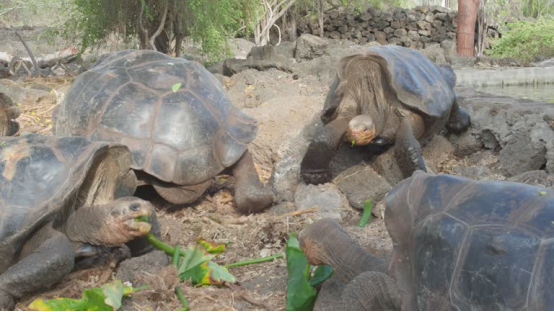
The tortoises are vegetarians, and their diet includes grass, cacti, leaves, and occasionally a few wild flowers. Although the resources seem abundant, their eating habits are unusually “restrained”. Once they feel full, they will stop eating immediately to avoid the health risks of overeating.
This moderation not only keeps their weight stable, but also avoids metabolic diseases. Scientists even believe that the tortoise’s diet is a natural version of “intermittent fasting,” which has also been shown in modern nutrition to help prolong life.
“Survival Wisdom” under the Tropical Sun
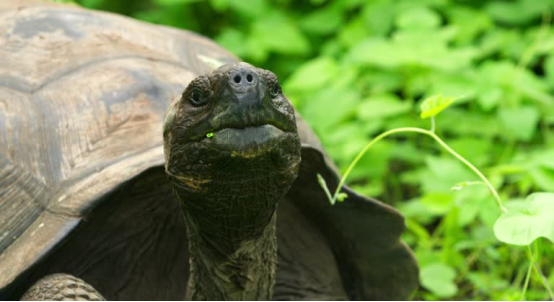
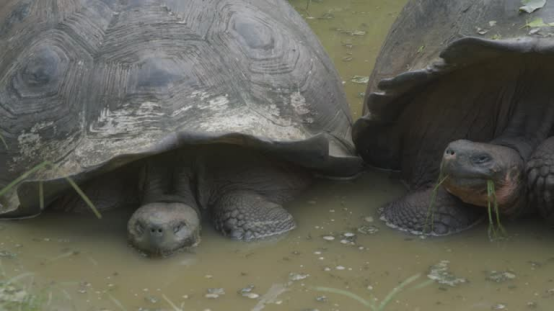
The Galapagos Islands are located near the equator, and the daytime temperature is often incredibly high. Although the giant tortoises have thick shells to protect them, they still need to be wary of heat stroke. Therefore, they have developed a survival wisdom: go out to forage in the morning, hide in the cool bushes at noon, or soak in the mud to cool down.
For those who are slow to react and fail to find shelter in time, high temperatures often mean death. This natural selection has enabled the giant tortoises to maintain their sensitivity to the environment and regular routines from generation to generation.
Love and reproduction: a century-long wait
February to June every year is the breeding season for giant tortoises. Male giant tortoises are usually twice as large as females, and this size difference makes the process awkward and difficult during mating. But for giant tortoises, it’s all worth it.
A male turtle may “date” multiple female turtles during the breeding season, and after successfully mating, the female will embark on another risky journey. She must return to the place where she was born, where there is soft sand and suitable for digging a nest and laying eggs. However, this journey is not easy.
The long journey home
What might seem like a morning run to a human being, a few kilometers can be a journey lasting a month or more to a giant tortoise. They traverse the terrain at a very slow pace, and modern environmental changes have made the journey even more challenging.
The jungle they remember in the past has been replaced by roads and fences, and invasive species have also increased the danger. This not only tests their physical strength, but also their tenacious will to survive.
Eventually, the female arrives at her destination, digs a nest, carefully lays down 16 or so ping-pong-ball-sized eggs , and covers them with sand, continuing a reproductive pattern that has lasted for millions of years.
New hope: the survival challenge of the little turtle
Four months later, the baby tortoises break out of their shells in the sand. They are only the size of their mother’s little finger and look fragile, but they are responsible for the mission of continuing their lives. They have to face predators, drought and harsh climate alone, and their survival rate is less than 10%. But those lucky survivors will have the opportunity to live to be over 100 years old in the future.
This “high-risk, high-reward” breeding strategy allows the tortoise population to be maintained, and every adult tortoise is the accumulation of countless miracles.
The Secret of Longevity: What Does Science Say?
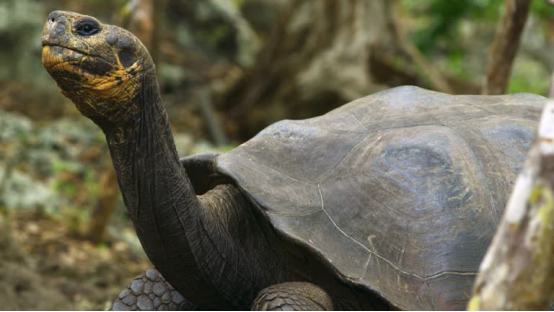
Scientists are very interested in the secret of the longevity of tortoises. Studies have found that they have specific gene mutations that can effectively repair DNA damage and reduce cell aging. In addition, their ultra-slow pace of life, low-calorie diet, and stable ecological environment are all important factors in delaying aging.
In other words, the longevity of tortoises is no accident, but the result of the combined effects of environment, genes and lifestyle.
Human thinking: What can we learn?
The story of the giant tortoise is not only a wonder of nature, but also a reminder to humans that longevity is not the result of a fast, intense life, but the product of moderation, stability and patience.
In a modern society that pursues speed and efficiency, we can perhaps learn from the tortoise the value of slowing down. Perhaps true health is not just about diet control or fitness plans, but about redefining the pace of life.
If you can choose to “slow down” like the tortoise, would you be willing to try it? Or do you think modern society allows us to slow down? Feel free to share your views in the comments section.