Educational note: This site publishes independent educational content for general readers. Articles about ecology, wildlife, conservation, pollution, animal behavior, or environmental risk are informational only and should not be treated as scientific, legal, regulatory, veterinary, medical, emergency, or professional advice. Consult qualified experts, peer-reviewed sources, and official local guidance before making decisions.
The love and ecological status of hornbills
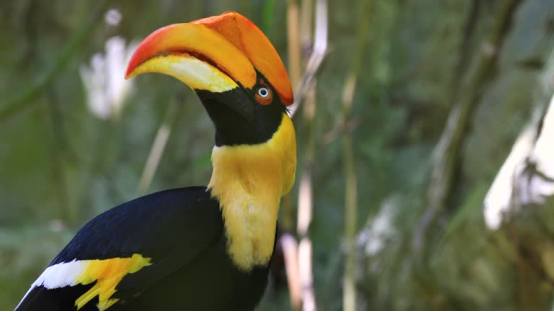
Hornbills are among the most iconic birds of the tropical rainforest. Their distinctive large beaks and vibrant plumage give them a crucial role in the ecosystem. Hornbills are known for their long-term pair bonds—they mate for life and never abandon one. This behavior is not only rare among birds but also provides ecologists with an excellent case study for studying long-term social bonds and reproductive strategies. Long-term pair bonds require close cooperation between the two individuals in every reproductive process, from nest building and foraging to egg incubation—every step reflects trust and dependence.
Hornbills primarily inhabit the tall tree canopies of tropical rainforests, where caves and tree hollows are crucial breeding and refuge sites. The choice of burrow and its internal structure directly influence the survival rate of their offspring, demonstrating their adaptability. To adapt to the limited space in tree hollows, hornbills employ sophisticated nesting techniques, including the use of feathers, soil, and even twigs to enhance comfort and safety.
A childhood sweetheart relationship
Bonds between hornbill pairs often begin to form during childhood. This early social bonding lays the foundation for long-term pair bonds in adulthood. In the rainforest, hornbill pairs develop tacit understandings through long-term coexistence, including coordinated foraging strategies, territorial defense, and reproductive behaviors. For example, when faced with predators or competitors, male hornbills display their agile flying skills and deft hunting abilities to protect the female and her future offspring.
Scientific observations show that male hornbills undertake the vast majority of foraging and food delivery during the pregnancy or egg-incubation period of their mates. This behavior not only ensures the survival of the female and her offspring but also strengthens the social bond between the pair. Males often traverse complex forests and jungles, capturing a variety of small prey and bringing them back to tree holes to provide the female with a rich supply of nutrients. This “food gifting” behavior is common among birds and is an important indicator of male reproductive capacity and parental investment.
Nest construction and maintenance
The tree holes chosen by hornbills often have limited space, but the comfort and safety of their nests are directly related to their reproductive success. During the breeding season, female hornbills use their own feathers to build their nests, even stained with a small amount of blood, to increase their softness and insulation. Scientific research shows that this behavior effectively reduces heat loss from eggs and chicks during incubation, thereby increasing hatching success rates.
The male hornbill is responsible for maintaining the nest entrance. To prevent predators and nest disturbance, he carries dirt or branches to block the entrance, reducing light and external threats, leaving only a narrow passage for the female to forage through her beak. This collaborative effort not only reflects the division of labor between the sexes but also demonstrates the hornbill’s highly intelligent and adaptable reproductive strategies.
Challenges of incubation and reproduction
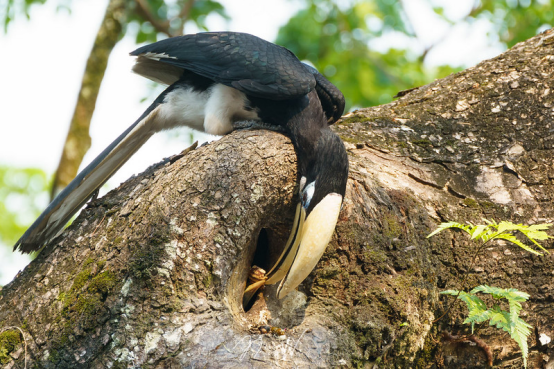
Hornbills have a relatively long breeding cycle, laying a limited number of eggs each time, yet they are crucial to population stability. Females typically lay one to two eggs, carefully incubating them in their nests. Males undertake almost all of the foraging during this period, potentially making dozens of trips through the trees daily to ensure the nutritional needs of the females and the eggs.
This intense parental investment is the core mechanism of long-term pair bonding. Scientists have documented that during the incubation period, male hornbills can fly an average of more than 10 kilometers per day, persisting in foraging even in high temperatures or windy or rainy weather. This behavior not only ensures the survival of their offspring but also maintains the emotional bond between the pair.
The birth of offspring and social structure
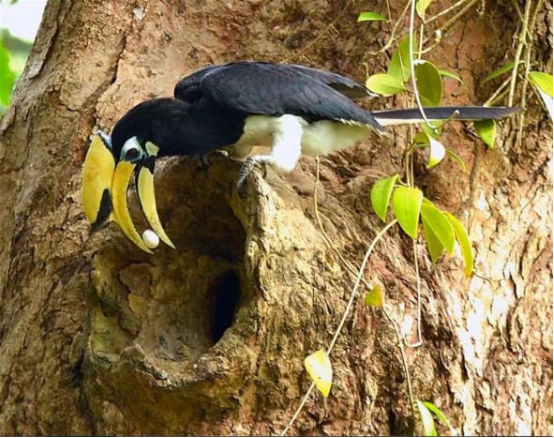
After months of incubation, hornbill eggs gradually hatch into chicks. In these early stages, chicks are completely dependent on their parents for food and protection, especially the female, who still needs to stay warm and safe in the nest. The male’s continued provision of food and defensive actions ensure the chicks’ successful growth.
Observations during this period revealed a strong collaborative nature within hornbill families: females are responsible for nest care, while males forage and defend the nest, monitoring potential predators. This clear division of labor helps increase chick survival and provides biological support for long-term pair bonding.
Impact on ecosystems
Hornbills play a crucial ecological role in rainforest ecosystems. They primarily feed on fruits and small prey and are crucial seed dispersals. Males carry food scraps and undigested seeds while foraging, which are then scattered across different areas, contributing to forest plant diversity. Furthermore, the selection and maintenance of hornbills’ nests provide habitats and refuges for other birds and small mammals, forming micro-ecological networks.
Furthermore, the long-term mating relationships and high-investment parenting behaviors of hornbills have a direct impact on population stability. If nest safety declines or the balance of mates is imbalanced, chick survival rates can drop significantly, impacting the reproductive efficiency of the entire population. Scientific research shows that protecting hornbill habitats, ensuring adequate food supply, and minimizing disturbances are key measures to maintain healthy tropical rainforest ecosystems.
Scientific Observation and Human Enlightenment
Hornbill behavior is not only valuable for ecological research but also offers emotional and ethical implications for human society. Long-term pair bonds and high-investment parental behavior embody a sense of responsibility, collaboration, and sacrifice—traits that contribute to population stability in avian societies and provide a paradigm for studying social bonding, emotional attachment, and behavioral ecology.
Observing hornbill breeding behavior also reminds us that ecosystem health is inextricably linked to the complex interactions between species. Conserving biodiversity isn’t just about protecting individual species; it’s essential for maintaining the functioning of entire ecological networks. The connection between hornbill nesting locations, reproductive strategies, and forest ecology demonstrates the profound impact of micro-behavior on macro-ecology.
Summary and Thoughts
The loyal love and reproductive wisdom of hornbills embody nature’s ingenious design. Research on nest site selection, mate coordination, reproductive investment, and ecological impacts can provide a deeper understanding of the ecological complexity of tropical rainforests. Their long-term pairing not only maintains family stability but also has profound impacts on forest ecosystems.
At a time when global biodiversity is under threat, the survival and reproduction of hornbills reminds us that ecological conservation requires meticulous attention. From nest construction to parental behavior, every action reflects the wisdom of nature and offers profound insights into ecological ethics: respecting nature, protecting habitats, and minimizing disturbance are crucial responsibilities for maintaining Earth’s ecological balance.
The story of the hornbill is not only a love legend, but also a vivid ecological lesson: small actions and long-term investment can determine the fate of a population and also affect the health and future of the entire ecosystem.