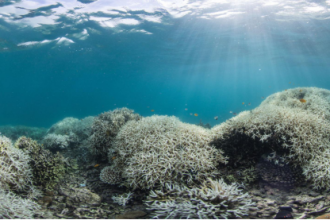
Oyster reefs can improve water quality because oysters filter algae and suspended particles from the water as they feed. At sufficient reef density and under suitable conditions, this can reduce turbidity and increase light penetration. But filtration is not the same as making material disappear: some particles become oyster tissue, while others are deposited on the bottom and may later be transformed, buried, or resuspended.
The result depends on oyster abundance, reef structure, water flow, temperature, salinity, food supply, sediment, and oxygen. An oyster reef is therefore an ecosystem process—not a universal water purifier.
What do oysters actually filter?
Oysters draw water across their gills and capture suitable particles. They consume phytoplankton and other organic material, while sorting or rejecting some particles. Removing suspended algae and particles can make water clearer and may help seagrasses or other submerged plants receive more light.
NOAA Fisheries’ oyster reef overview says that an oyster can filter as much as about 50 gallons of water per day under favorable conditions. This is a conditional upper figure, not a fixed daily rate for every oyster. Temperature, oyster size and health, food concentration, sediment load, salinity, and flow all change filtration.
Multiplying “50 gallons” by an oyster count does not reliably predict how quickly an entire bay will be cleaned. Water may pass the same reef more than once, particles may settle or return to suspension, and hydrodynamics determine which water reaches the oysters.
Where do filtered particles go?
Filtered material can follow several paths:
- Assimilation: Some carbon and nutrients become oyster tissue or shell-associated biomass.
- Feces and pseudofeces: Consumed and rejected particles are packaged into larger deposits that settle near the reef.
- Microbial processing: Microorganisms decompose deposited organic matter and recycle nutrients.
- Resuspension: Currents, waves, or disturbance can return some deposited material to the water column.
- Burial: A fraction may remain in accumulating sediment for a longer period.
Water clarity can improve even when nutrients have only moved from the water column to oyster tissue or sediment. To claim permanent removal, a study must show what happened after filtration.
The four-step water-quality pathway
| Step | What happens | Useful evidence | What can limit the result |
|---|---|---|---|
| 1. Filter | Oysters capture algae and suspended particles. | Clearance rate, chlorophyll, suspended solids, and turbidity. | Low oyster density, unsuitable salinity or temperature, heavy sediment, disease, and low oxygen. |
| 2. Transfer | Material enters oyster biomass or is deposited as feces and pseudofeces. | Oyster biomass and sediment-deposition measurements. | Resuspension and rapid recycling can return material to the water. |
| 3. Transform | Microbes process deposited material; some nitrogen may be converted through denitrification. | Sediment nitrogen fluxes and process measurements. | Temperature, oxygen, sediment, organic loading, and reef setting affect microbial pathways. |
| 4. Remove | Nitrogen leaves through harvested biomass, conversion to nitrogen gas, or longer-term sediment burial. | Harvested nitrogen, denitrification, and burial estimates. | Temporary storage or unmeasured transfer should not be counted as permanent removal. |
How oyster reefs can affect nitrogen
Oysters do not simply absorb all nitrogen from water. Nitrogen associated with food can enter oyster tissue. If oysters are harvested, that tissue-bound nitrogen is physically removed from the water body. Deposited material can also stimulate sediment processes. During denitrification, microorganisms convert biologically available nitrogen into nitrogen gas, which leaves the aquatic system. Some nitrogen can instead be buried in sediment.
These pathways vary by site. A PLOS ONE study published on March 25, 2026 analyzed sediments sampled in 2011 from 20 experimental Eastern Oyster reefs in Back Sound, North Carolina. Nitrogen burial rates generally increased with reef relief and oyster density. Intertidal flat reefs had the greatest relief, oyster densities, and burial rates, while subtidal flat reefs had the lowest relief and burial rates. Because the reefs were 11 to 14 years old and represented three habitat settings in one temperate Atlantic estuary, these relationships do not provide a universal nitrogen-removal rate for every restoration project.
Why results change from one site to another
A dense reef in moving water can encounter more suspended food than scattered oysters in poorly connected habitat. Yet very fast flow may reduce particle capture or increase resuspension. Salinity and temperature affect feeding and survival, while prolonged low oxygen can suppress activity or kill oysters. Excess sediment can clog feeding structures or bury young oysters.
Reef height and three-dimensional structure also matter. Elevated reefs may experience different oxygen, sediment, and flow conditions than low-relief deposits. Disease, harvest pressure, predation, larval supply, and the availability of firm substrate influence whether a reef persists long enough to provide water-quality functions.
How to judge whether restoration is working
Adding shell or counting planted oysters records an action, not an ecological outcome. A useful monitoring plan separates reef condition from water-quality response:
| Evaluation area | Example indicators | What success would show |
|---|---|---|
| Reef structure | Area, height, relief, and persistence. | The physical reef is developing rather than flattening or eroding. |
| Oyster population | Live density, biomass, recruitment, growth, and survival. | A self-maintaining population is forming under site conditions. |
| Water column | Chlorophyll, suspended solids, turbidity, light, and dissolved oxygen. | Relevant conditions improve compared with an appropriate baseline or reference. |
| Nitrogen pathway | Tissue nitrogen, denitrification, sediment flux, and burial. | Transfer, transformation, and actual removal are distinguished. |
Restoration may also create habitat and, in some settings, reduce wave energy or help stabilize a shoreline. Those benefits should be measured separately rather than assumed from filtration alone.
Clearer water does not guarantee safe oysters
Ecological filtration is not drinking-water treatment and is not a food-safety test. Oysters can accumulate pathogens, biotoxins, heavy metals, and other contaminants from surrounding water. A visibly clear site can still be unsafe for harvest or consumption.
Water-quality improvement claims therefore cannot override official harvest classifications, closures, testing, or public-health guidance. Restoration reefs may also be created for habitat rather than food production. This article explains ecosystem processes and does not assess the safety of oysters from any location.
The bottom line
Oyster reefs can improve water clarity by filtering algae and suspended particles, then redirecting material into biomass and sediment pathways. Lasting nitrogen removal requires an additional step such as harvest, denitrification, or burial. Judge a project with site-specific reef, population, water-quality, and nitrogen measurements—not with a filtration-rate multiplication alone.
Source note: the NOAA page and PLOS ONE article linked above were checked on September 18, 2026. The four-step matrix is an explanatory synthesis, not a site assessment or food-safety standard.