Educational note: This site publishes independent educational content for general readers. Articles about ecology, wildlife, conservation, pollution, animal behavior, or environmental risk are informational only and should not be treated as scientific, legal, regulatory, veterinary, medical, emergency, or professional advice. Consult qualified experts, peer-reviewed sources, and official local guidance before making decisions.
The Secret Life in the Tree Hole
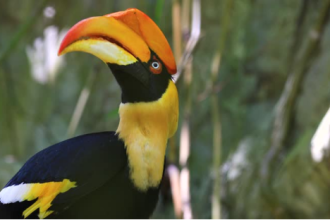
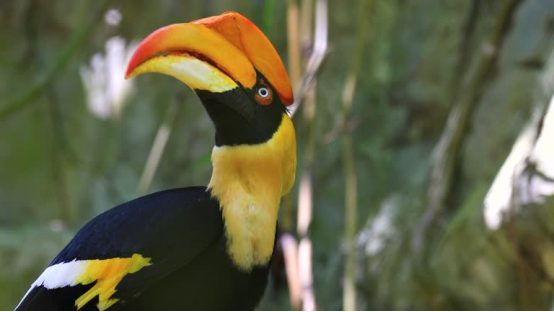
If you see a tree in the rainforest with only a pair of eyes showing on the trunk, don’t be surprised or afraid. That is the love story of the hornbill quietly unfolding. The female hornbill will seal herself in the tree hole, and she will live in this small space that can only accommodate one bird for the next six months. The hole is sealed with mud and saliva, leaving only a small gap for breathing and eating. In a sense, this is a kind of “self-imprisonment”, but it is not forced, but out of dedication to life and family.
This is an extreme interpretation of trust, because once she enters the tree hole, her life is completely dependent on the care of her partner. And this choice is the marriage declaration of the hornbill world.
Loyal love: a sample of monogamy in nature
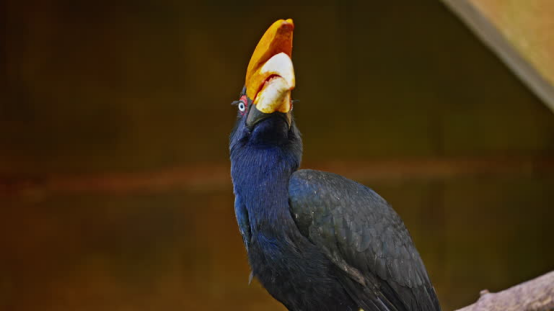
Hornbills are one of the few birds that strictly practice monogamy. In nature, long-term partnerships are not common, and many birds will go their separate ways and find new mates after the breeding season. However, hornbills are different. Their marriages may last for many years or even for life.
This behavior is more than just romantic; it is an evolutionary strategy: to increase the survival rate of young birds through deep parental cooperation. Females are responsible for incubating eggs and raising chicks, while males bear all the risks in the outside world, gathering food and guarding the territory. This is a typical “responsibility family.”
Scientists speculate that this pattern has been preserved over millions of years of evolution because it greatly improves the survival chances of offspring.
The test of love: the male bird’s “survival license”
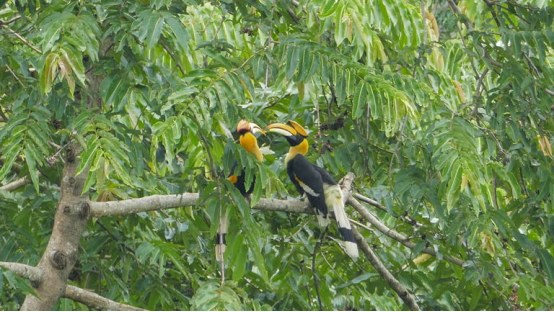
However, this long-term partnership does not start easily. The female hornbill will put the male bird through a rigorous test before mating. It is not just a display of feather beauty or the elegance of the song, but a hardcore test of survival ability.
In the records of nature documentaries, male birds must fly over areas densely populated with bats, complete the crossing without disturbing the bats, and successfully bring back high-quality fruits. Why fruits? Because fruits are the main food for female birds and future chicks, representing the ability to provide for them.
This “mission” not only tests the male bird’s dexterity, but also its patience and physical strength. If it can complete the task in a high-risk environment, it proves that it has sufficient resource acquisition capabilities and is trustworthy.
Tree Hole Transformation: The Ultimate Sense of Security
Once the male bird passes the test, the female bird will choose a safe tree hole as the wedding room. She will use the soil brought by the male bird and mix it with her own saliva to completely seal the hole, leaving only a narrow gap for eating and excreting.
This extreme “closed management” not only protects the female bird from predators, but also keeps the temperature inside the cave stable, preventing eggs and chicks from being damaged by climate fluctuations.
Inside the hole, the female plucks her own feathers to create a soft “mattress” for her future chicks. It’s a tender and sacrificial act, as losing her feathers makes her more vulnerable, but her maternal drive makes her happy.
Six-month long race: life and death of the male bird
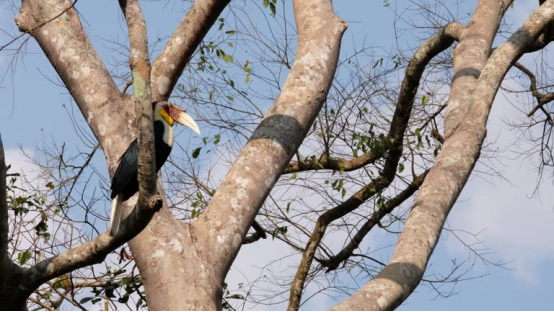
For the next six months, the male bird will be solely responsible for the food supply for the entire family. Scientific research shows that during a breeding cycle, the male bird may need to provide more than 10,000 fruits and search for insects, seeds, and even small animals in different areas to ensure balanced nutrition.
However, the rainforest is not a supermarket, and resources are distributed extremely unevenly. In order to find enough food, male birds must fly for several kilometers, cross areas infested by predators, and even risk storms.
This is a marathon-like effort, and the male bird never backs down. They maintain their lives in the cave by going back and forth again and again.
Food Pickiness: The “Little Emotions” in Marriage
However, long-term monotonous diet can make female birds picky eaters – scientists have observed that they will refuse certain foods and even spit fruits directly out of the hole. This is not pretentious, but physiological needs. Carrying eggs and feeding young birds consumes a lot of energy, and female birds need high-energy, high-protein food to maintain their physical strength.
For the male bird, this means a higher challenge: it must look for scarce high-nutrition food, even at the risk of its life, to go to a farther area. This makes the question of “what to eat tonight” in human marriage seem like child’s play.
The cost to the family: the pressure of multiple lives for one bird
Over time, the holes contain not only female birds, but also chicks waiting to be fed. Interestingly, scientific observations have found that sometimes not all the chicks in the nest are from the current mate, which means that in some cases, the female bird may have mated with other males before closing.
Although this phenomenon is rare, it reveals the complex reproductive strategy of nature: genetic diversity is an insurance mechanism. Even if the current male bird is not strong enough, the offspring still have the opportunity to obtain excellent genes.
For the male bird, this may be the ultimate scapegoat moment. Even if the chick is not its genetic successor, it will still do its best to provide for the entire family. This unconditional dedication is admirable and also reminds people of the role of “stepfather” in human society.
Why work so hard?
Some people may ask: Why do hornbills choose such a costly reproduction method? The answer is “evolutionary game”. In the tropical rainforest with huge predation pressure, eggs and chicks exposed to the outside are very easy to be killed by predators. Sealing tree holes is an extreme protection strategy that greatly increases the survival rate of chicks.
The male bird’s extra-long feeding behavior is an evolutionary adaptation to this strategy. Simply put, this is a case of “risk transfer” in an ecosystem: the male’s labor is exchanged for the safety of the female and the offspring.
Revelation to mankind: Love is a long-term investment
The story of the hornbill is not only a natural wonder, it also provides us with a reflection on trust, sacrifice and responsibility. A truly stable relationship is never a momentary romance, but a long-term investment and the courage to take responsibility under high pressure.
In modern society, we may not need to fly across the jungle and risk our lives to find fruits, but we also face the problem of “supply” in our emotions: time, patience, and understanding are all scarce resources. The hornbill tells us that love is not a short performance, but a “marathon” that requires persistence.
If you had to be like a hornbill, confined in a tree hole for six months, completely dependent on your partner for care, would you dare to try it? Feel free to share your thoughts in the comments section.