Educational note: This site publishes independent educational content for general readers. Articles about ecology, wildlife, conservation, pollution, animal behavior, or environmental risk are informational only and should not be treated as scientific, legal, regulatory, veterinary, medical, emergency, or professional advice. Consult qualified experts, peer-reviewed sources, and official local guidance before making decisions.
When the rainforest smells sweet: the monsoon story of jackfruit
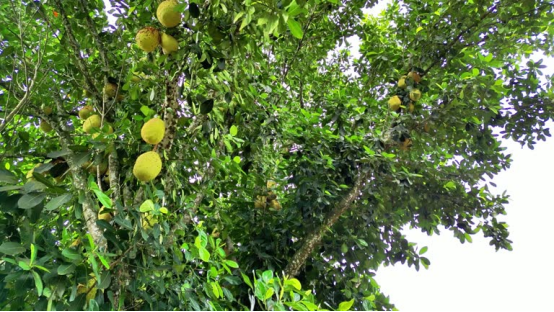
The arrival of the monsoon season every year means that life in the rainforests of southern India reaches its climax. Heavy rains wash over the treetops, the smell of earth fills the air, and in this natural symphony, there is a special “note” – the sweet fragrance of jackfruit.
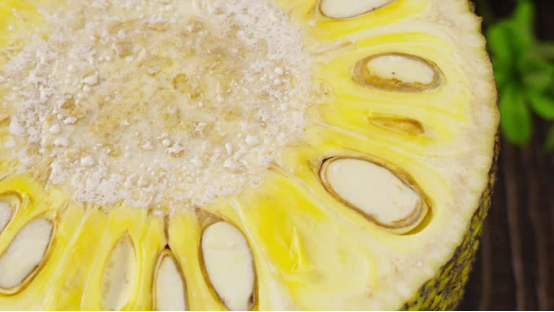
These large fruits, sometimes weighing up to 20 kilograms, hang from the branches like sweet treasures hidden under green armor. When they are ripe, the flesh turns an attractive yellow color and the smell is so strong that it can be smelled from several meters away. It is not only a tropical delicacy for humans, but also a source of energy that countless creatures in the rainforest dream of.
However, in this seemingly rich tropical paradise, foraging for food is never an easy task. Especially for the most active “eaters” in the area – long-tailed macaques. They have to face not only a huge number of fruits to choose from, but also a “technical problem”: how to judge whether the fruit is ripe?
Sweet Trap: Why are monkeys afraid of eating unripe fruit?
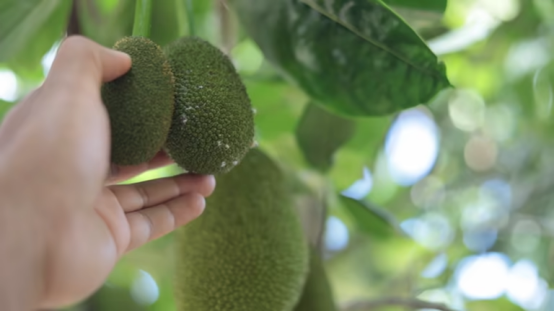
At first glance, the densely hanging jackfruits seem within easy reach, but the monkeys cannot just gnaw blindly. If they eat unripe fruits, they may suffer from gastrointestinal discomfort at best, or even serious poisoning due to the strong tannins and latex.
In other words, this is not just a fight over food, it’s a matter of life and death. Scientific research shows that many primates rely on experience or “olfactory signals” to judge the ripeness of fruits, but the surface of jackfruit does not change color significantly, which makes judgment extremely challenging.
It’s like a human being facing a pile of seemingly perfect avocados, but not sure which one is just ripe. However, for monkeys, the cost is higher: once a mistake is made, it may not only be “bad taste”, but also health or even life.
Primates’ outsourced wisdom: The helpless role of giant squirrels
Faced with this survival problem, the monkeys have developed a surprising “solution” – outsourcing services. Who is the object? It is another resident of the rainforest: the Indian giant squirrel .
This rodent with bright fur and a tail longer than its body is known for its keen sense of smell and is an expert at judging the ripeness of fruit. The monkeys have long been aware of this, so they began to adopt a strategy of “forced cooperation” – kidnapping giant squirrels and forcing them to “detect fruit” for them.
When the giant squirrel carefully selected a ripe jackfruit and prepared to eat it, a monkey would suddenly attack from behind and snatch the fruit away, leaving the squirrel with almost no sweetness.
From an ecological perspective, this is a classic example of kleptoparasitism , where one animal relies on the foraging skills of another animal and only “harvests” itself. Similar strategies are not unfamiliar in human society either—it’s like the “old hands” in the office who don’t do their homework but steal the results of a project.
The struggle of giant squirrels: the plight of the underdog
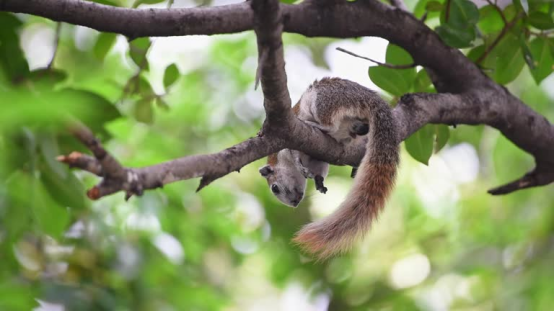
The giant squirrels that were deprived of food did not completely fail to react. Scientists observed that they would protest by making high-frequency calls and even slapping tree trunks, and some individuals even tried to hide in higher branches. However, these actions seemed powerless in the face of the team fighting of primates.
In nature, weak species are often at a disadvantage in the battle for resources. Therefore, most giant squirrels eventually choose to “strategically retreat” and look for new food sources.
This reveals a thought-provoking ecological philosophy: in an environment with limited resources, the strong not only win through physical strength, but also seize the initiative through wisdom and sociality.
The ecological risks behind jackfruit: sweetness and danger coexist
A ripe jackfruit is a treasure trove of energy, but it also carries risks:
Energy Concentrate : The ripe fruit is high in sugar and water, making it an important source of energy intake for primates.
Predator ambush : Jackfruit trees often become predation hotspots, with predators such as leopards and pythons ambushing around the fruit trees because they know that herbivores and primates are bound to gather there.
Disease transmission : Areas where fruit accumulate can also become breeding grounds for parasites and pathogens, posing a potential threat to monkeys, squirrels, and even humans.
Social wisdom in the rainforest: Why are monkeys so smart that they will do anything to achieve their goals?
The monkeys’ exploitation of giant squirrels is not just predatory, but also a strategic behavior. This strategy reflects the highly developed cognitive ability of primates: they know how to use the skills of others to save energy and maximize benefits.
This kind of “cognitive flexibility” is common in primate societies. For example, capuchin monkeys use stones to crack nuts, chimpanzees use branches to fish for termites, and baboons cooperate to obtain food. Human evolution has developed along this path of “innovation and collaboration.”
Reflection of human society: Are we also fighting for “jackfruit”?
When you read the story of the monkey snatching the squirrel’s fruit, does it feel familiar? It is very similar to the “resource competition” in the modern workplace, or the model of strong companies “acquiring” small businesses in the business world. The survival logic of nature reflects the competitive nature of human society to some extent.
This also raises an intriguing question: In a world with limited resources, how can we find a balance between cooperation and fairness?
Ecological coexistence: The outcome of this war is not zero-sum
Although the monkeys seem to be in control, giant squirrels still play an irreplaceable role in the ecosystem. They maintain the diversity of the rainforest by chewing fruits and spreading seeds. Scientists point out that if the number of giant squirrels decreases sharply, the regeneration of plants such as jackfruit will be seriously affected, which will in turn affect the entire rainforest ecological chain.
In other words, this is not a simple “winner takes all” game, but a delicate balance: although the actions of the strong bring injustice, the ecosystem maintains stability through complex interactions.
what will you do?
If you were a giant squirrel, would you choose to resist or give in? Or would you try to establish a “cooperative relationship” with the monkey, such as exchanging other resources to achieve a win-win situation?
The answer given by nature may be: flexibility, adaptation and cooperation are the ultimate rules of survival.
What do you think? Let us know in the comments: Is this “jackfruit war” more like a natural necessity or cruel exploitation?