Educational note: This site publishes independent educational content for general readers. Articles about ecology, wildlife, conservation, pollution, animal behavior, or environmental risk are informational only and should not be treated as scientific, legal, regulatory, veterinary, medical, emergency, or professional advice. Consult qualified experts, peer-reviewed sources, and official local guidance before making decisions.
Hippopotamus: Cute pets but also killers
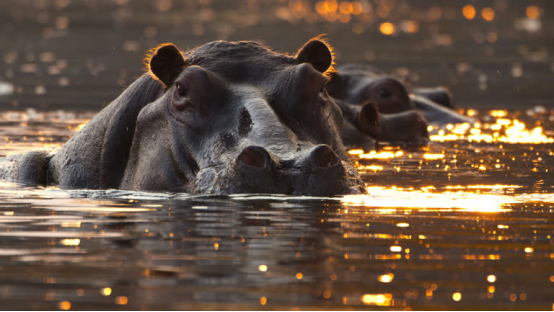
When you think of Africa, you might think of lions, cheetahs, and giraffes, but the real overlords of the rivers are the seemingly honest hippos. They are not only the third largest land mammals on Earth (after elephants and rhinos), but also one of the African animals that causes the most human casualties each year.
In many people’s impressions, hippos are “Buddhist”: eating grass, soaking in water, basking in the sun, and never seem to have any worries. But the fact is that the survival wisdom, social order and ecological role of this animal are far more complicated than we imagine. Today, let us unveil the mystery of hippos.
Scene 1: Gentle beasts in the water? No, they are “hardcore players”
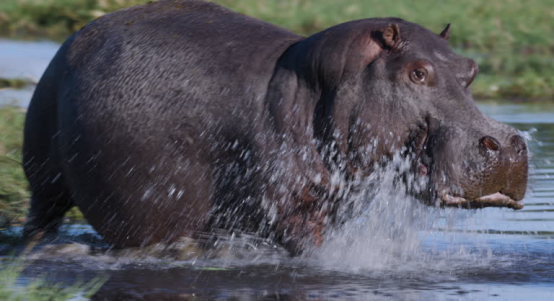
Hippos may look like “horses in the water”, but they are not close relatives of horses. In fact, hippos’ closest relatives are whales! Modern molecular biology shows that whales and hippos have a common ancestor in evolution, which also explains the high dependence of hippos on the water environment.
They spend most of their lives in water, not just to “enjoy the spa,” but to survive. The African sun can heat the soil to over 70 degrees Celsius, and long-term exposure is enough to dehydrate and crack the skin. So hippos invented their own “natural sunscreen” – a red body fluid that can resist ultraviolet rays and has antibacterial effects. Scientists call it “blood sweat,” but it actually has nothing to do with blood.
Does it look a bit like the “sunscreen spray” that humans use? The only difference is that we have to go to the supermarket to buy it, while hippos have their own “skin care black technology”.
Act 2: Eating vegetarian food, yet growing to 3 tons?
Don’t be fooled by their fierce reputation, hippos are actually strict vegetarians, with a daily diet mainly consisting of grass. They leave the water every night and walk several kilometers to find food. Adult hippos can weigh 1.5 to 3 tons, which means they have to eat at least 40 kilograms of plants every day to maintain their huge bodies.
But what’s interesting is that they are very self-disciplined and rarely overeat. Once they feel full, they will stop eating. This kind of “self-control” is rare in nature. Think about it, if you stand in front of the buffet every day, facing endless desserts, and still know when to stop, isn’t it harder than a hippopotamus?
However, scientists have also found that in extreme drought or habitat destruction, hippos may exhibit “abnormal eating behaviors,” including eating carrion or even attacking other animals. This is not a change in personality, but a strategy forced by survival pressure.
Act 3: Underwater social network: “win-win cooperation” between fish and hippos
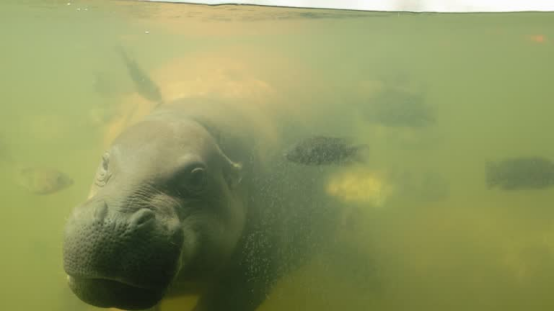
Hippos not only live in water, they also do business in the water. The core of this business is fish therapy .
Hippos have thick skin, which easily accumulates dead skin and parasites between their wrinkles. Every day, they excrete a large amount of feces that float on the water surface and become a feast for fish. This forms a well-known mutualistic symbiosis in ecology : fish obtain nutrition, while hippos enjoy free “skin care” and “oral cleaning services.”
Doesn’t it sound like a spa package in the animal world? Even better, this relationship not only maintains the health of the hippos, but also helps maintain the nutrient cycle in the water, indirectly benefiting the entire ecosystem.
Act 4: The violent nature beneath the gentle appearance
Don’t be fooled by their cute appearance, hippos are the real “African thugs”. The number of human deaths caused by hippo attacks each year is higher than the total number of lions and crocodiles. There are three reasons for this:
Strong sense of territory : Hippos are naturally protective of their calves and have a strong possessiveness of water areas. Any intruders will be ruthlessly expelled.
Incredible speed : They thrive in water and can run at speeds of up to 30 kilometers per hour. In other words, if you encounter an angry hippo in Africa, you can’t outrun it.
Deadly weapon : A huge mouth with a bite force of up to 1,800 pounds, which can easily chew through a canoe.
These characteristics make hippos the real “invisible killer” in Africa. Imagine that you are shooting a National Geographic blockbuster on a quiet river surface at sunset, but the next second, a huge shadow rushes out from underwater – this is the worst nightmare for African travelers.
Scene 5: Crisis of the drought season and ecological chain reactions
Africa’s dry season is the ultimate test for hippos. The water area has shrunk dramatically, and dozens of hippos have to squeeze into small muddy pools. The originally comfortable “private swimming pool” has become a “swamp poison soup” full of urine, feces and germs. This harsh environment has led to the outbreak of deadly diseases, the most common of which is anthrax , which can kill a large number of hippos in a short period of time.
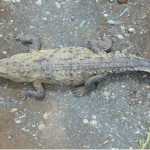
At the same time, the dry season is also a “carnival” for crocodiles. When hippos fall due to disease or hunger, crocodiles become the biggest beneficiaries. This is a typical natural cycle: the weak fall, the strong fill their stomachs, and the ecosystem maintains balance in cruelty.
Act 6: Hippos and the cultural imagination—why are they so fascinating?
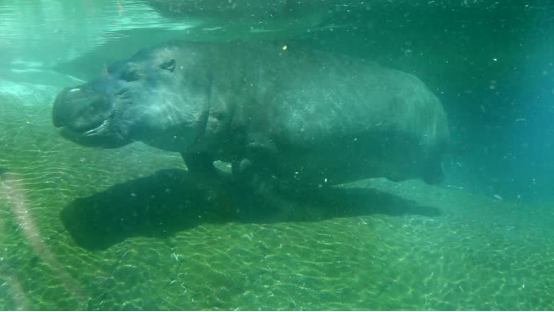
Why do hippos always attract our attention? Perhaps it is their cute contrast: on the one hand, they are lazy “fat Buddhas” in the water, and on the other hand, they are cold and ruthless “violent aesthetics” on the grassland.
In popular culture, hippos have even become a symbol of humor and strength. From the children’s book “Ms. Hippo” to the animated film “Madagascar” in Moto Moto, hippos are portrayed as clumsy and cute characters. But if you really think of them as “gentle beasts”, you really underestimate their fighting value.
Ending: What do you think? Is the hippo a “gentle fat guy” or an “African killer”?
The survival strategies of hippos have both a warm side (mutualism, social order) and a cruel side (territorial disputes, dry season fighting). They remind us that nature is never a simple black and white world, but a survival drama full of trade-offs, compromises and wisdom .
If you travel in Africa and like to watch hippos by the river, think about this question: Are you seeing a quiet “spa expert” or a lurking “ultimate hunter”?
What do you think? Let us know in the comments: If you had the chance to spend an hour with a hippo, would you take a photo or just run away?