Educational note: This site publishes independent educational content for general readers. Articles about ecology, wildlife, conservation, pollution, animal behavior, or environmental risk are informational only and should not be treated as scientific, legal, regulatory, veterinary, medical, emergency, or professional advice. Consult qualified experts, peer-reviewed sources, and official local guidance before making decisions.
Who is it? A “mobile fortress” from 30,000 years ago
When we talk about prehistoric animals, people usually think of mammoths, saber-toothed tigers, and woolly rhinos. However, 30,000 years ago, there lived another lesser-known but legendary beast on the plains of South America: Doedicurus.
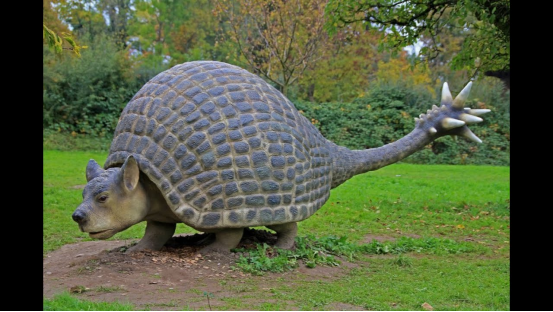
It looks like a giant armored warrior, with heavy bone armor on its back and a weapon like a “meteor hammer” at the end of its tail. Its survival strategy can be described as “absolute defense + ultimate counterattack.” Because of this unique way of survival, it has become a nightmare for predators in its long evolutionary history.
Prehistoric ecology: the golden age of giants
To understand the existence of the new tailed beasts, we must look at the era in which they lived. 30,000 years ago, the climate in South America was relatively warm, with grasslands and savannas widespread, giving birth to a large number of large mammals. This was the golden age of giant beasts, with saber-toothed tigers, dire wolves, ground sloths, mammoths, etc. forming different levels of the ecological pyramid.
Survival in such an environment is never an easy task. Being large in size means both strength and huge energy requirements. Without effective defense, any negligence could make these animals prey to top predators.
It was under such ecological pressure that the new tailed beasts evolved heavy armor and “armed tails”, forming one of the most representative defense systems in the prehistoric animal kingdom.
Armored Construction: Nature’s Tank Design
The body of the new tailed beast is covered with hard bone armor plates, which are not only thick but also arranged in a honeycomb pattern, which can resist external impact without adding excessive weight. Scientists speculate through fossil research that this armor can play an amazing protective effect when resisting bite forces.
What’s even more interesting is that the end of its tail is a huge bony ball-like structure, sometimes even with spikes. This is not just a decoration, but a real weapon. Imagine that when a scorpion (a prehistoric large cat) tried to attack it, it only needed to swing its tail, and the “bolas” weighing tens of kilograms was enough to crush the attacker’s bones.
This combination of defense + counterattack gives the new tailed beasts an overwhelming advantage in the competition for survival.
Predator’s Challenge: Desperate Moments for the Rentooth Tiger
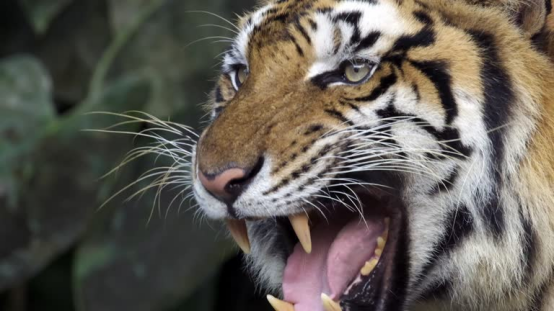
However, the prehistoric world has never lacked adventurers. As a top predator, Ren-toothed Tiger, with its sharp teeth and powerful bite force, has tried countless times to break through the “defense fortress” of the new tailed beasts.
Archaeologists speculate that Ren-chi Tiger may have adopted the strategy of going around to the side or attacking from the abdomen, because the abdomen of the new tailed beast is relatively weak. But the problem is that it is almost impossible to make the new tailed beast turn over – it weighs up to 1.5 tons, equivalent to a small truck. Even if Ren-chi Tiger tried his best, it would be difficult to shake it.
This contest of strength and wisdom often ends with the predator returning empty-handed. Scientists have found in fossil remains that many of the new tailed beast skeletons have almost no signs of predation, which shows that its defense is almost impeccable.
Family and reproduction: the warm side of prehistoric society
The new tailed beast is not just a “war machine”, it is also an animal with group behavior. Through the distribution of fossils and coprolites, scientists speculate that they may move in small groups to increase the success rate of defense and protect their offspring.
Female shinbimon need to find relatively safe areas during the breeding season to prevent their young from becoming prey to other predators. This defensive instinct is similar to that of modern armadillos or pangolins, which also curl up into a ball and protect themselves with a hard shell when in danger.
Why is such a powerful being still extinct?
The question is: Why did such a powerful “mobile fortress” eventually go extinct? The scientific community generally believes that climate change and human activities are the key factors.
About 10,000 years ago, the climate in South America changed dramatically, and vegetation decreased, making the food that the new tail beasts depended on scarce. At the same time, the appearance of early humans further increased their survival pressure. Archaeological evidence shows that humans not only hunted these giant beasts, but also used fire to drive them away. This multiple pressure eventually led to their extinction.
Comparison with Modern Animals: Who are the “New Tailed Beasts” Today?
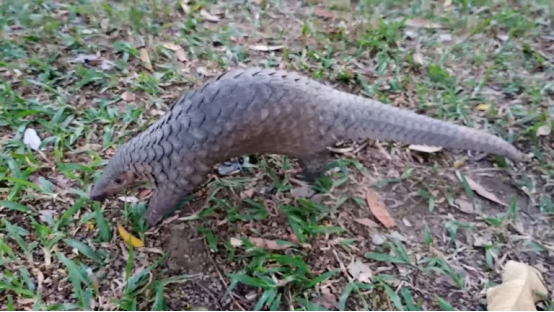
Today, we can still see the shadow of the new tailed beast in armadillos and pangolins. They also rely on hard shells to defend against predators. Although they are much smaller, their survival strategies are surprisingly similar.
This evolutionary logic that transcends time and space reveals a natural law: in a world where the strong prey on the weak, survival depends not only on sharp teeth, but also on thick armor and flexible strategies.
Human enlightenment: the “defense philosophy” of modern society
The story of the new tailed beasts is not only an interesting anecdote of paleontology, but more like a metaphor: when facing danger, the most effective strategy is not necessarily to attack, but to build a strong enough defense.
In modern society, this “armor” may not be physical protection, but psychological resilience, knowledge reserves or social relationships. When the external environment is full of uncertainty, internal stability and protection mechanisms are our core strength to resist risks.
Conclusion: Will you choose to be a “warrior” or a “fortress”?
If you were asked to survive in the prehistoric world, would you choose to be an agile hunter, or build a solid defensive fortress like the new tailed beasts? Or, which strategy do you think is more needed in modern society? Feel free to share your views in the comments section.