Educational note: This site publishes independent educational content for general readers. Articles about ecology, wildlife, conservation, pollution, animal behavior, or environmental risk are informational only and should not be treated as scientific, legal, regulatory, veterinary, medical, emergency, or professional advice. Consult qualified experts, peer-reviewed sources, and official local guidance before making decisions.
Dung beetles, often overlooked, are some of the most fascinating and ecologically vital insects on the planet. These tireless workers dedicate their lives to a seemingly humble resource: animal excrement. Yet, from this material, they build their homes, feed their young, and inadvertently provide critical services that support entire ecosystems. This guide explores the incredible power and intricate behaviors of dung beetles, revealing how a simple ball of dung becomes the cornerstone of their existence and a boon for the environment. We will delve into their unique life cycle, their extraordinary navigational abilities, and their classification, providing a comprehensive look at these unsung heroes of the natural world.
The Unsung Heroes: Ecological Importance of Dung Beetles
While their choice of resource may seem unglamorous, the work of dung beetles is essential for the health of pastures, forests, and savannas. They are premier examples of ecosystem engineers, modifying their environment in ways that benefit countless other species, including humans.
Nutrient Cycling and Soil Aeration
By burying dung, these beetles transport a rich source of nutrients, particularly nitrogen, deep into the soil. This process, known as bioturbation, not only fertilizes the soil but also improves its structure. The tunnels they dig aerate the ground, increasing water absorption and reducing runoff, which helps prevent soil erosion and promotes healthy plant growth.
Parasite and Pest Control
Fresh dung is a breeding ground for pests like bush flies and intestinal parasites that can harm livestock and wildlife. Dung beetles are remarkably efficient at removing dung from the surface, often within minutes or hours. This rapid cleanup disrupts the life cycle of these pests, reducing their populations and contributing to the overall health of grazing animals.
Secondary Seed Dispersal
Many animals consume fruit, and their seeds pass through their digestive tracts intact. When dung beetles collect and bury this dung, they also bury the seeds. This protects the seeds from predators and places them in a nutrient-rich, well-aerated environment ideal for germination, helping to regenerate plant life.

The Art and Science of the Dung Ball
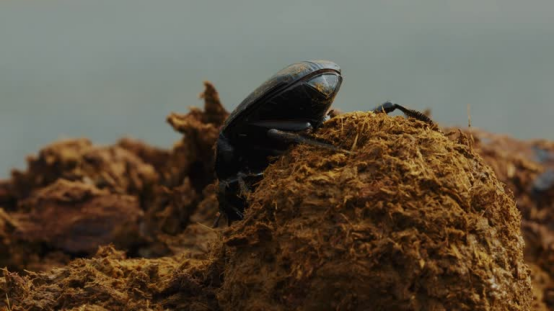
The creation and transportation of a dung ball is the most iconic behavior associated with certain dung beetle species. This process is a marvel of instinct, strength, and sophisticated biology, involving far more than just random pushing.
Sourcing and Shaping the Perfect Ball
Using highly sensitive antennae, dung beetles can detect the odor of fresh dung from a great distance. Upon arrival, they use their specialized, spade-like heads (clypeus) and strong front legs to expertly carve and shape a perfectly spherical ball. The spherical shape is ideal for rolling, minimizing friction and making it easier to transport over uneven terrain.
Celestial Navigation: An Astronomical Feat
One of the most astonishing facts about dung beetles is their ability to navigate using celestial cues. To escape the chaotic competition at a dung pile, they must move in a perfectly straight line. By day, they use the sun’s position and the polarization pattern of sunlight. At night, they use the polarized light of the moon and, incredibly, the faint stripe of the Milky Way galaxy as a compass. This makes them the only known non-vertebrate animal to navigate using our galaxy.
Overcoming Obstacles and Competition
The journey is fraught with peril. The beetle must navigate backward, pushing the ball with its hind legs. This leaves it vulnerable to predators and “kleptoparasites”—other dung beetles that try to steal its hard-earned prize. If the beetle encounters an obstacle, it will often climb atop its ball to re-orient itself with the sky before continuing on its straight path.

More Than Food: The Dung Beetle Life Cycle
A dung ball is not just a meal; for many species, it is a nuptial gift, a home, and a nursery for the next generation. The life cycle of a dung beetle is intrinsically linked to the dung they collect.
The Nuptial Chamber
After rolling the ball a safe distance away, a male and female pair will work together to bury it in an underground chamber. This buried ball, known as a “brood ball,” becomes a protected and climate-controlled environment. The dung’s exterior hardens, shielding the interior from predators and temperature fluctuations.
From Egg to Larva
The female lays a single egg inside the brood ball. Upon hatching, the larva (or grub) finds itself completely encased in its food source. It spends its entire developmental stage eating the dung from the inside out, growing larger in a safe, subterranean environment.
Emergence of a New Generation
After consuming the interior of the brood ball and passing through several larval stages (instars), the larva pupates. It transforms into an adult beetle within the hardened shell of the remaining dung. When the transformation is complete and environmental conditions are right (often after rainfall softens the soil), the new adult beetle emerges from the ground to begin the cycle anew.

Dung Beetle Strategies: A Comparative Overview
Not all of the 6,000+ species of dung beetle roll balls. Based on their behavior, they are broadly classified into three main functional groups, each with a unique approach to utilizing dung.
| Beetle Type (Guild) | Behavior and Strategy | Ecological Impact |
|---|---|---|
|
Rollers (Telecoprids) |
These are the iconic species that form dung into balls and roll them away from the source before burying them for feeding or breeding. | Excellent at moving nutrients across a landscape. Their transportation of dung reduces competition and parasite concentration at the source. |
|
Tunnelers (Paracoprids) |
These beetles land on a dung pat and immediately begin digging a tunnel directly beneath it, dragging portions of dung down into the tunnels. | Extremely effective at soil aeration and rapidly incorporating nutrients deep into the soil profile, significantly improving soil health. |
|
Dwellers (Endocoprids) |
These species live and breed directly within the dung pat itself. They do not move or bury the dung. | Their impact on soil improvement is minimal compared to the others, but they contribute to the initial breakdown of the dung pat on the surface. |
Frequently Asked Questions (FAQ)
-
Why do dung beetles roll dung in a straight line?
- Rolling in a straight line is the most efficient way to escape the intense competition from other beetles at the dung pile. Moving straight ensures they get their valuable resource to a safe burial spot as quickly as possible, minimizing the risk of it being stolen. They use celestial cues like the sun, moon, and Milky Way to maintain their bearing.
-
Are dung beetles strong?
- Yes, they are famously strong for their size. A dung beetle can push a ball that is over 50 times its own body weight. In terms of proportional strength, this is equivalent to an average human pushing an object weighing around 40 tons. This incredible strength is necessary to move their dung balls over rough terrain.
-
Do dung beetles only eat dung?
- While their primary food source is the liquid, nutrient-rich content within animal excrement, some species have different diets. Certain dung beetles specialize in carrion (dead animals), decaying fungi, or rotting fruit. However, the vast majority are coprophagous, meaning they feed on dung.
-
How can we help protect dung beetle populations?
- Protecting dung beetles is crucial for healthy ecosystems, especially in agricultural settings. The most significant action is the responsible use of veterinary medicines, particularly anti-parasitic drugs (avermectins) in livestock, as these chemicals pass into the dung and can be lethal to beetle larvae. Promoting diverse habitats and avoiding broad-spectrum insecticides also helps support their populations.